XXI Young Researchers Workshop on Geometry, Dynamics and Field Theory#
January 13–15, 2027, Institut Camille Jordan, Université Lyon 1
Important dates
- 15 November 2026 – Deadline for contributed talk applications
- 15 December 2026 – Registration and poster submission deadline
- 13-15 January 2027 – Workshop
Register here - Registration is free.
The Young Researchers Workshop on Geometry, Dynamics and Field Theory is a yearly event for early-career researchers in the field of differential geometry and its relations to dynamics and field theory. The 21st edition will take place at the Institut Camille Jordan, University Claude Bernard Lyon 1, in Lyon. This event offers researchers in the field, especially the younger participants, a platform to share their latest results with an international audience and discuss current topics. The workshop will feature three mini-courses in key topics in the field, contributed talks selected from participants’ submissions, and a poster session.
The previous edition took place in Loughborough in March 2026.
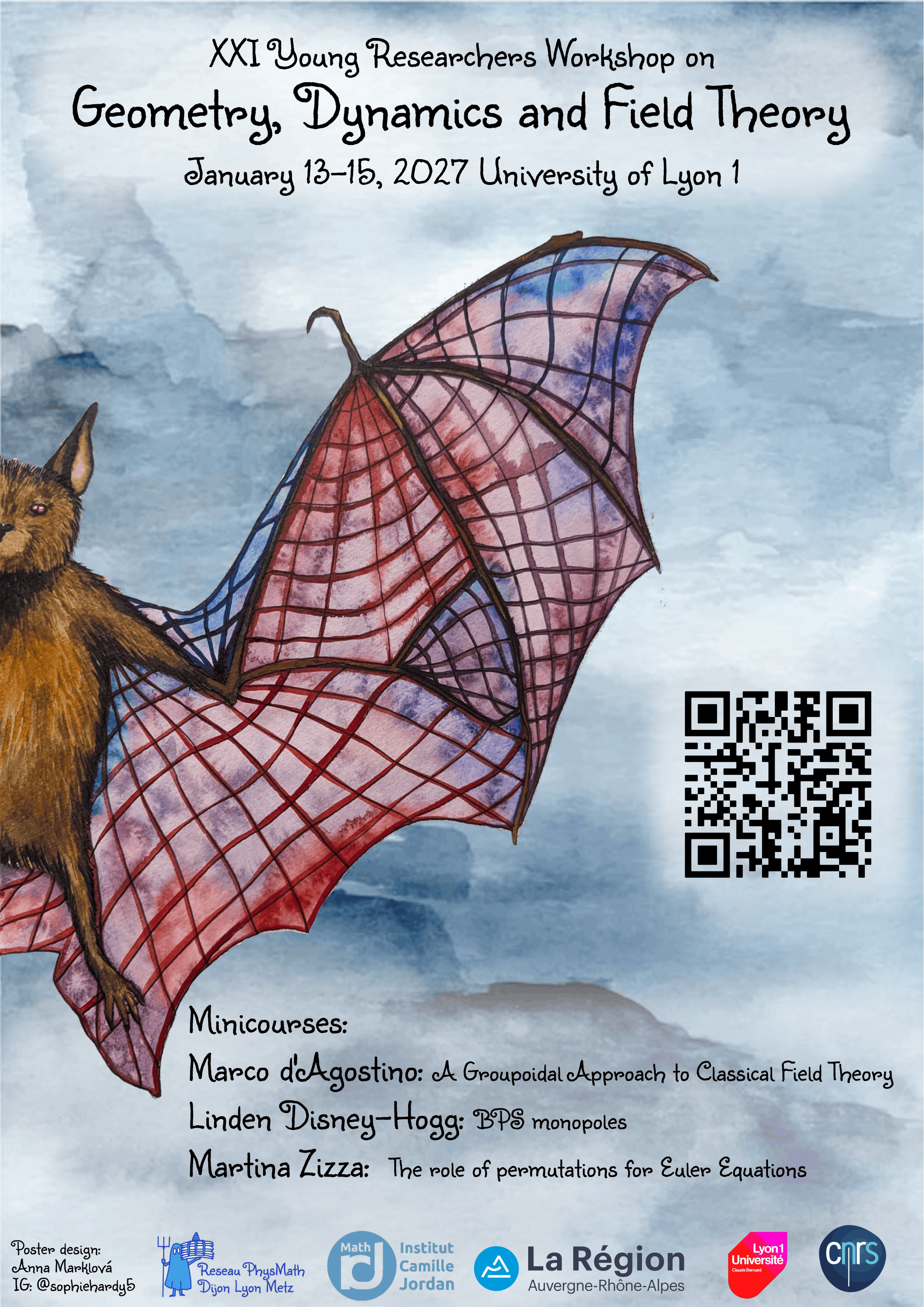
Download the workshop poster (PDF)
Minicourses#
Marco Valerio d’Agostino#
INSA Lyon
A Groupoidal Approach to Classical Field Theory#
Abstract: Classical field theories are often formulated in terms of spaces of fields acted on by symmetry groups. This description is effective in many situations, but it hides an important geometric feature: the symmetries of a field theory are typically local and gauge-dependent. Lie groupoids provide a flexible language for encoding precisely this kind of local symmetry.
The aim of this lecture series is to present a groupoidal approach to classical field theory. We will start from the basic geometric objects of field theory, and explain how they can be reorganised in terms of Lie groupoids, Lie algebroids, bisections and jet groupoids. Particular attention will be given to the passage from global symmetry groups to local symmetry groupoids, and to the interpretation of gauge theories as moduli problems.
A central theme will be the replacement of naïve quotient spaces of fields by quotient groupoids and differentiable stacks, which retain stabilisers, local automorphisms and Morita-invariant information. This viewpoint gives a natural framework for treating gauge symmetries, infinitesimal symmetries, Noether-type structures, connections, and higher geometric objects such as gerbes and higher gauge fields.
Linden Disney-Hogg#
Imperial College London
BPS monopoles#
Abstract: BPS monopoles are solitons in gauge theory, motivated by their history in theoretical physics through the quantisation of electric charge and their inevitability in grand unified theories. Their fantastic geometry makes them the perfect lens through which to view some key themes driving progress over the last 50 years, in particular
- the study of gauge theoretic moduli spaces,
- the interaction between gauge theory and algebraic geometry, and
- the connection to linearised integrable systems.
The lectures shall use the trichotomy of monopoles, spectral curves, and Nahm’s equations to give a taste of these themes.
Martina Zizza#
MPI for mathematics in the sciences, Leipzig
The role of permutations for Euler Equations#
Abstract: In this course, we present Arnold’s variational formulation of the Euler equations, which interprets the motion of an ideal fluid as geodesic motion on the space of volume-preserving diffeomorphisms. Since this infinite-dimensional space is challenging to study directly, we turn to a natural discrete analogue: permutations of the cubes in a discretized fluid domain. Fluid motion can then be viewed as a sequence of elementary rearrangements, reminiscent of the moves used to solve a Rubik’s Cube. This discrete viewpoint establishes a connection between fluid dynamics, geometry, and combinatorics, and offers a new perspective on the study of fluid motion through the tools of discrete mathematics.
Programme#
The detailed programme will be announced shortly.
The workshop will take place from Wednesday 13 January to Friday 15 January 2027.
Contributed talks#
Participants may apply to give a contributed talk when registering for the workshop.
The deadline for contributed talk applications is 15 November 2026. Proposals will be reviewed by the scientific committee, and selected participants will be contacted by organisers. If the number of submissions exceeds the available talk slots, priority will be given to early-career researchers.
The list of contributed talks will be announced after the selection process.
Poster session#
Participants are also welcome to present a poster. Poster submissions can be indicated directly on the registration form.
The deadline for poster submissions is 15 December 2026.
Registration#
Registration is free. To participate, please fill in the registration form.
When registering, you can also indicate whether you would like to :
- give a contributed talk.
- present a poster.
- or attend the workshop without presenting.
| Deadline | |
|---|---|
| Contributed talk applications | 15 November 2026 |
| Poster submissions | 15 December 2026 |
| Registration | 15 December 2026 |
Participants are expected to arrange and fund their own travel and accommodation. Unfortunately, due to budget constraints, we are unable to offer financial support for travel or accommodation.
Venue#
The workshop will take place at the Institut Camille Jordan, on the Lyon-Tech-La Doua campus of Université Claude Bernard Lyon 1, in salle Fokko du Cloux (1st floor).
Bâtiment Braconnier, 21 avenue Claude Bernard, 69622 Villeurbanne.
The campus is served by tram T1 and T4, at the Université Lyon 1 stop.
Getting to Lyon and to the venue#
Lyon is easily accessible by train, coach and plane from France and many European cities
By train – Lyon Part-Dieu#
Lyon Part-Dieu is Lyon’s main railway station. It is served by frequent high-speed trains from Paris and other major French cities, as well as by direct international services from several European cities, including Geneva, Brussels, Frankfurt, Turin and Milan. Connections from Spain, including Barcelona, are also available with a change.
From Lyon Part-Dieu, the easiest way to reach the campus is by tram T1 or T4 (located at each side of the station). Get off at Université Lyon 1, close to the Bâtiment Braconnier.
By train – Lyon Perrache#
Lyon Perrache is Lyon’s other main railway station, located in the city centre. It is served by numerous regional and national trains.
The tram T1 provides a direct connection from Perrache to the LyonTech–La Doua campus. Get off at Université Lyon 1. Or via Metro A get on at Perrache, change to tram T1 or T4 at Charpennes - Charles Hernu, then get off at Université Lyon 1.
By coach#
Long-distance national and international coaches arrive at the Gerland International Bus Station, which is served by operators such as FlixBus, BlaBlaCar Bus and Itabus.
Lyon has direct coach connections with many cities in France and neighbouring European countries, including Geneva, Turin, Milan, Barcelona, Brussels and Madrid.
The bus station is conveniently connected to the workshop venue by tram T1. Get on at Debourg and get off at Université Lyon 1. Or via Metro B get on at Stade de Gerland, change to tram T1 or T4 at Charpennes - Charles Hernu, then get off at Université Lyon 1.
By plane#
Lyon Saint-Exupéry Airport (LYS) offers direct connections with a large number of European cities, including London, Amsterdam, Brussels, Frankfurt, Munich, Madrid, Lisbon and Rome, among many others.
The Rhônexpress tram connects the airport with Lyon Part-Dieu railway station in approximately 30 minutes. From Part-Dieu, continue to the campus by tram T1 or T4 and get off at Université Lyon 1.
Please note that Rhônexpress is not included in the standard TCL fare system and has its own separate tickets and pricing (currently 16.30€ for a one-way ticket).
Local public transport#
Lyon’s metro, tram and bus network is operated by TCL. The workshop venue is particularly easy to reach by tram T1, which directly connects Perrache, Debourg, Part-Dieu and Université Lyon 1. Tram T4 also provides a direct connection from Part-Dieu.
A standard journey within Lyon (TCL zones 1 and 2) currently costs 2.10€ and is valid for one hour, including transfers between buses, trams and metro lines - Rhônexpress excluded. For occasional travel, there is no need to buy a ticket in advance : contactless payment is available throughout the TCL network.
For up-to-date routes and timetables, please consult the TCL website or app before travelling.
Accommodation#
The workshop venue is well connected by public transport to central Lyon. Accommodation can therefore conveniently be booked either near the LyonTech-La Doua campus or in the central areas with easy tram or metro connections to the campus.
Convenient areas include :
- Part-Dieu, particularly practical for participants arriving by train or plane;
- Charpennes, with convenient connections to the campus and city centre;
- Villeurbanne, close to the university.
Food around the campus#
For workshop participants visiting the Institut Camille Jordan, lunches during the workshop will be covered for external participants and served at the university staff restaurant.
Several cafés, bakeries and restaurants can also be found in and around the campus. For dinner, the nearby Brotteaux district and Lyon’s 6th arrondissement offer a wide range of restaurants. Local institutions include Brasserie des Brotteaux; further into the city, Brasserie Georges, near Perrache, or Café des Fédérations near the Hôtel de Ville.
For vegetarian and vegan dining, Brocoli, on rue Masséna in the 6th arrondissement, offers an entirely plant-based menu.
And of course, feel free to ask the local organizers for recommendations – we will be happy to share some of our favourite places.
Previous editions#
The Young Researchers Workshop on Geometry, Dynamics and Field Theory has been organised annually at different European institutions.
- XX — Loughborough, 2026
- XIX — Verona, 2025
- XVIII — Warsaw, 2024
- XVII — Leuven, 2023
- XVI — Barcelona, 2021
- XV — Utrecht (online), 2020
- XIV — Göttingen, 2019
- XIII — Coimbra, 2018
- XII — Padova, 2018
- XI — La Laguna, 2017
- X — Paris, 2016
- IX — Zaragoza, 2015
Organization#
Local organizing committee:#
Scientific committee#
- Xavier Rivas – Universitat Rovira i Virgili – Tarragona, Spain
- Tobias Diez – Shanghai Jiao Tong University – Shanghai, China
- Juan Margalef Bentabol – Université de Montréal – Montréal, Canada
- Rodrigo T. Sato Martín de Almagro – Friedrich-Alexander-Universität Erlangen-Nürnberg – Erlangen, Germany
- María Amelia Salazar – Universidad EAFIT – Medellín, Colombia
- Maria Teresa Chiri – Queen’s University – Kingston, Canada
- Jordi Gaset – CUNEF Universidad – Madrid, Spain
- Mats Vermeeren – Loughborough University – Loughborough, United Kingdom
Support#
The workshop is hosted by the Institut Camille Jordan, Université Claude Bernard Lyon 1, and organized within the Réseau PhysMath.
It is supported by the CNRS and the Région Auvergne-Rhône-Alpes.
Poster design : Anna Marklová - Instagram.
Contact#
In case of questions please contact Leonid Ryvkin (ryvkin@math.univ-lyon1.fr).